Oran
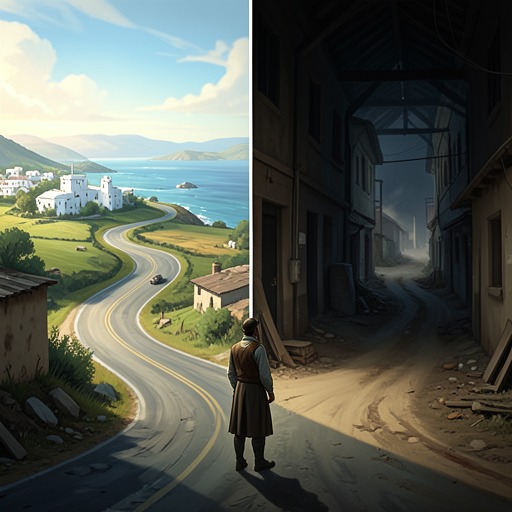
The Myth of SisyphusOran is the central setting of “The Minotaur, or The Stop in Oran,” and its decisive significance lies in the way it converts a real city into a philosophical landscape. Rather than offering the historical beauty associated with European cultural capitals, Oran presents dust, stone, oppressive streets, boredom, and an indifferent sky. Precisely because almost nothing in it invites aesthetic or historical contemplation, it becomes a difficult place of retreat in which the human creature, deprived of ornament and distraction, is forced into view.
A City Chosen Against Poetry
Oran belongs to a meditation on the need for solitude within modern cities. Deserts and islands have disappeared, yet the need for them remains: one must sometimes turn away from the world in order to understand it and hold others at a distance in order to serve them better. European cities are too crowded with the noise of the past, their stones carrying revolutions, fame, empires, and accumulated memory. Paris can become a desert for the heart, but Père-Lachaise Cemetery can suddenly release a revolutionary wind; Salzburg remains marked by Mozart and by the cry of Don Juan; Vienna stands at a crossroads of history. Such places are never entirely silent because their cultural inheritance continues to speak.
Oran offers an opposite kind of solitude. The desert has already been filled with poetry and made sacred by the sorrows attached to it, so another form of desolation is required: a place without soul, reprieve, or inherited beauty. Descartes found a comparable solitude in Amsterdam, the most mercantile city of his era, where he could walk freely amid a crowd as quietly as along garden paths. Oran extends this principle into a harsher environment. It is valuable not because it uplifts the spirit or satisfies the hunger of memory, but because it refuses to do so.
Physical Form and Mineral Landscape
The people of Oran live before a wonderful landscape but have responded to that ordeal by covering the city with ugly constructions. A visitor expects an open city refreshed by the evening breeze from the sea; instead, except in the Spanish quarter, the town turns away from the water. It is described as a walled settlement that curls inward like a snail, a great circular yellow wall beneath a leaden sky. The city’s architecture therefore becomes an image of enclosure: the sea is present, but the built environment denies access to it.
The first movement through Oran is a search for the sea, as though the traveler were following the sign of Ariadne through a labyrinth. Yet the streets lead repeatedly back into pale and oppressive circuits. The city’s circularity defeats escape and gives its boredom a spatial form. What appears at first to be wandering becomes repetition; what promises orientation becomes enclosure.
Stone dominates the city so completely that the pebble becomes its emblem. Shopkeepers display pebbles in their windows to hold papers in place or simply for display, while piles of stones remain along the streets for years. Elsewhere, poetry is drawn from the vegetable world; in Oran, vegetation acquires a stony face. The roughly hundred trees in the business district are covered with dust, their branches giving off an acrid smell, as though the city had petrified its own plants. Above the Ras-el-Ain ravine, fields of pale, friable pebbles face the sea and reflect the sun with blinding force, while an occasional purple geranium supplies a brief pulse of life amid the bare bones of the earth.
From Les Planteurs, the cliffs surrounding Oran appear so deep and mineral that the landscape becomes unreal and man seems outlawed from it. From the roads climbing Santa-Cruz, the city first appears as scattered colored cubes; higher up, jagged cliffs crouch around the plateau like red beasts, while sun and wind sweep over the rocky landscape, airing out and obscuring the disorder below. The resulting opposition is between magnificent human anarchy and the permanence of an unchanging sea. Oran is not empty of life, but its life is set against an elemental world that appears older, harder, and indifferent to human arrangements.
The Minotaur of Boredom
The city’s labyrinth produces its own monster. As the traveler turns through the pale streets in search of the sea, the Minotaur eventually devours the people of Oran. Here the Minotaur is boredom. The mythic image does not lead to an adventure beyond the labyrinth; it names a condition that has become ordinary. The citizens have stopped wandering and accepted being eaten, so the city’s oppressive repetition is not merely imposed from outside but incorporated into daily existence.
This boredom is connected to the absence of distraction. Oran’s mineral sky, dusty streets, and dust-covered trees create a dense and impassable universe in which the heart and mind cannot escape themselves or their sole object, man. Florence and Athens can move people to tears or uplift them because their historical meanings quiet spiritual hunger with the bread of memory. Oran has no such consolations. Its ugliness is anonymous, its past is reduced to almost nothing, and its sky is indifferent. The question is therefore not what cultural meaning the city preserves, but what remains when cultural meaning no longer shelters consciousness.
That remaining presence is the human creature. For a certain kind of person, wherever the human being is beautiful becomes a bitter native land, and Oran is one of its thousand capitals. The city’s apparent lack of attraction becomes an austere ethical and psychological resource: it denies the visitor the easy escape into monuments, tradition, or picturesque scenery and leaves human existence exposed against emptiness.
Public Life and the Street
Oran’s social life follows the same resistance to elevated culture. Its inhabitants complain that there is no interesting circle, while attempts by a few “right-thinking people” to import the customs of another world produce little of value. The circles that remain instructive are those of poker players, boxing enthusiasts, bowlers, and local associations. These groups are not presented as refined intellectual institutions; their importance lies in the unsophisticated, practical forms of companionship they preserve.
The city consequently places a certain nobility outside the lofty sphere. Those who seek it leave the circles and go into the street. The street becomes an alternative to organized cultural prestige, a place where the city’s inhabitants meet without pretending that art or ideas require an exclusive social world. In this setting, Oran’s lack of an “interesting circle” is not simply a social deficiency. It exposes the sterility of cultivated elevation and redirects attention toward common activity, bodily competition, local association, and direct contact.
The contrast with Amsterdam clarifies the point. Descartes could find silence amid a noisy crowd because the city allowed him to choose his relation to other people. Oran offers a more severe version of the same possibility. Its inhabitants are surrounded by others, but the city’s ugliness and boredom make companionship neither automatically meaningful nor automatically consoling. Solitude must be made within public life, not discovered in a picturesque wilderness.
Narrative and Thematic Significance
Oran is both a geographical location and a constructed counter-image to Europe’s historic cities. The essay explicitly warns that its account dates from 1939 and that the contemporary city may have remedied the imperfections described, while the beauties praised have been preserved. This temporal qualification separates the literary Oran from any claim to permanent factual description. The city functions as an argument, but the argument remains anchored in a specific urban landscape of circular walls, stone, dust, cliffs, sea, and sun.
Its governing movement is a form of defamiliarization. Familiar urban features are made strange by being rendered as a labyrinth, a snail, a mineral matrix, or a landscape from which man has been expelled. A pebble becomes an exhibited object; trees become petrified plants; boredom becomes a mythic devourer. These transformations do not beautify Oran. They make its ordinary ugliness newly perceptible and delay the automatic judgment that a city must be attractive, historic, or spiritually nourishing to matter.
Oran’s significance finally rests on its refusal of consolation. It is a place in which the past offers little shelter, poetry has been stripped away, and the sky remains indifferent. Yet that very deprivation creates the possibility of solitude, clarity, and attention to human beings. The city is therefore not simply a failed Mediterranean setting or a picturesque desert. It is a hard-edged instrument of perception: a place where boredom closes the labyrinth, where stone replaces foliage, and where the absence of inherited meaning leaves existence standing alone.